
3606 Maclay Blvd, Suite 104, Tallahassee, FL
Facelifts are often described as a matter of surgeon preference — different techniques, same outcome. But the face isn’t that simple. It’s dynamic, expressive, and deeply anatomical. And when it comes to truly restoring what time has shifted, not all facelift techniques are created equal. The deep plane facelift represents a modern evolution in facial rejuvenation — one designed to lift what has actually descended, not simply tighten what remains.
As we age, the face doesn’t just develop loose skin. Deeper structures — particularly the SMAS layer — gradually descend. Traditional facelift techniques that rely on tightening, folding, or partially excising this layer are inherently limited. Without fully releasing the SMAS, the ability to reposition the face back to a more youthful, natural position is compromised.
The deep plane facelift works differently. By completely releasing the SMAS and repositioning it as a unit, this technique restores facial anatomy rather than simply camouflaging aging. The result is a lift that respects natural vectors, avoids unnatural tension, and moves the way a face should — especially when smiling, speaking, or expressing emotion.
The face is one of the most expressive parts of the human body. When tension is placed on tissues that haven’t been released, subtle distortions can appear — especially with animation. These small inconsistencies are often what give rise to the “operated” look. Deep plane facelifting minimizes this risk by allowing tissues to move freely and naturally after surgery.
Modern facial rejuvenation isn’t about pulling harder — it’s about lifting smarter. The deep plane facelift allows for elegant correction of facial descent, often earlier than older techniques, and with results that feel natural, balanced, and timeless.
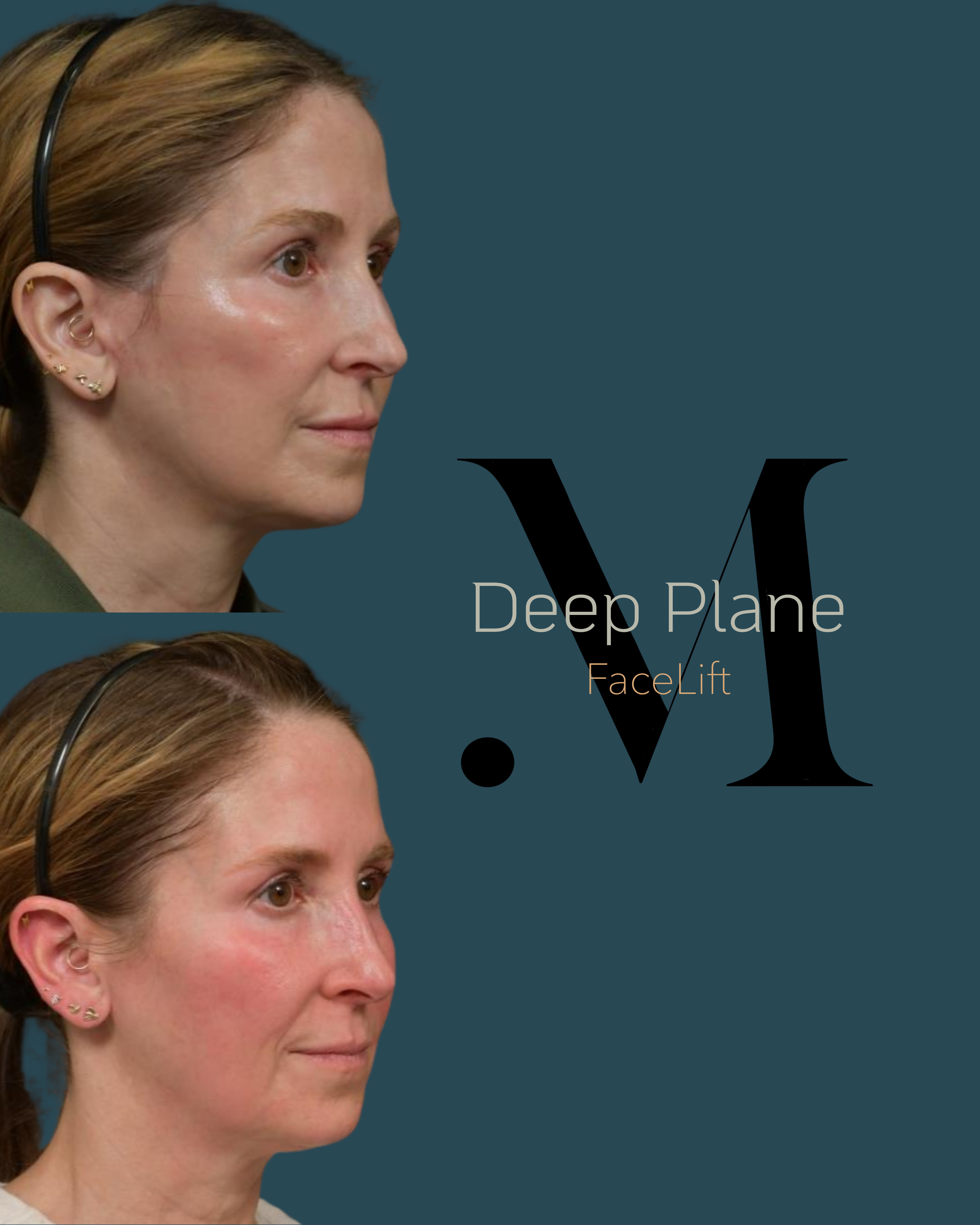
Shown here is an example of a woman in her early forties who was bothered by subtle but persistent midface descent. She underwent a mini deep plane facelift — still fully releasing and repositioning the descended structures, but using abbreviated incisions and without a formal neck lift. The result is a natural restoration of facial contours, preserving her expressions and movement. She looks like herself — just refreshed and younger.
Explore our gallery and schedule a consultation at Moderne Aesthetic Plastic Surgery to see if this modern technique is right for you.


